
Blog

Your blog category

Blog

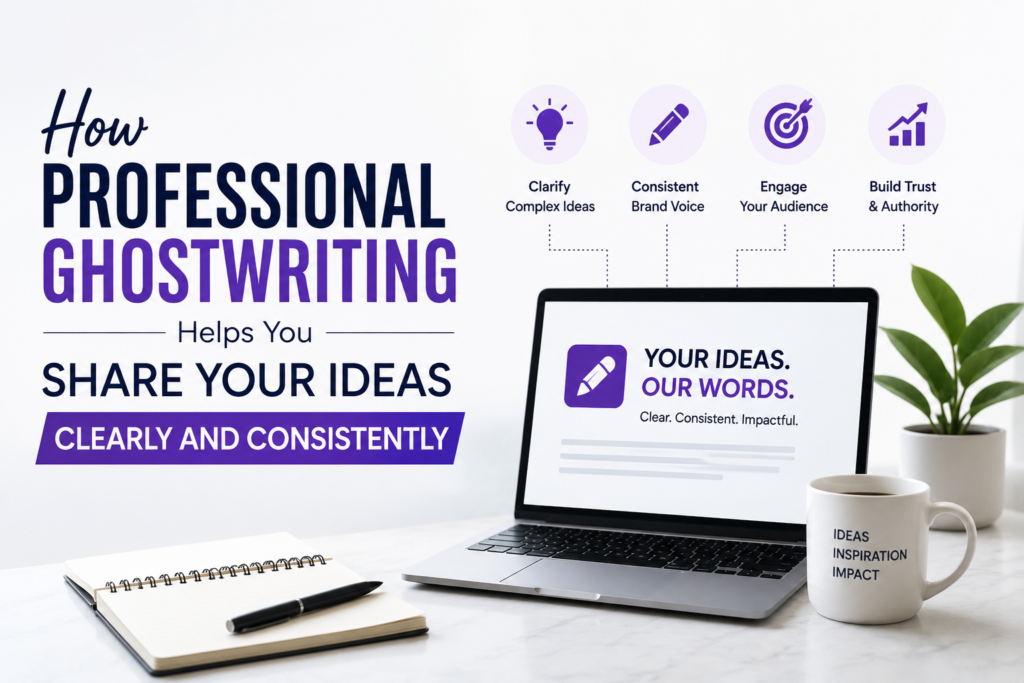
How Professional Ghostwriting Helps You Share Your Ideas Clearly and Consistently

Many business owners, founders, and professionals have valuable ideas—but struggle to express them clearly and consistently. This is where professional ghostwriting services come in. Ghostwriting is not just about writing content for you. It’s about capturing your voice, organizing your thoughts, and turning your ideas into clear, engaging, and consistent content that builds your brand. In this blog, you’ll learn how ghostwriting helps you communicate better, stay consistent, and grow your authority. 1. Turning Ideas into Clear, Structured Content Most people don’t lack ideas—they lack structure. You may know what you want to say, but putting it into a clear and logical format can be challenging. Professional ghostwriters specialize in transforming scattered thoughts into well-organized content. They help you: Define your main message Break ideas into clear sections Remove unnecessary complexity Deliver content that is easy to understand Why it matters: Clear communication makes your message more effective and easier for your audience to connect with. 2. Maintaining a Consistent Brand Voice Consistency is key to building trust and recognition. But maintaining a consistent voice across all your content can be difficult—especially when you’re busy. A professional ghostwriter: Learns your tone and style Adapts to your brand voice Ensures consistency across all platforms Whether it’s blog posts, eBooks, or website content, your message remains aligned and professional. Key Insight: A consistent voice makes your brand more recognizable and trustworthy. 3. Saving Time While Staying Visible Creating high-quality content takes time—time many professionals don’t have. Ghostwriting allows you to: Focus on your core business activities Stay active online without writing everything yourself Maintain a regular content schedule Instead of struggling to write occasionally, you can publish consistently with ease. Why it matters: Consistency increases visibility, and visibility builds authority. 4. Improving Content Quality and Engagement Professional ghostwriters understand what makes content engaging and effective. They focus on: Writing clear and compelling headlines Using simple, reader-friendly language Structuring content for readability Including calls-to-action where needed This results in content that: Keeps readers engaged Communicates value quickly Encourages action Key Insight: Better content leads to better results—more engagement, more trust, and more conversions. 5. Supporting Multiple Content Types Ghostwriting services go beyond blog posts. They help you create different types of content that support your business goals. This includes: Blog writing (SEO-friendly and engaging) eBook writing (in-depth, lead-generating content) Website content (clear and conversion-focused messaging) By working with a ghostwriter, you ensure all your content is aligned and professional. Why it matters: A unified content strategy strengthens your overall brand presence. 6. Helping You Build Authority and Trust Consistent, high-quality content positions you as an expert in your field. When your ideas are communicated clearly and professionally: Your audience understands your value You build credibility You attract the right clients Ghostwriting helps you show up as a thought leader without the stress of writing everything yourself. Key Insight: Authority is built through consistent, valuable communication. 7. Making Complex Ideas Easy to Understand If your work involves technical or complex topics, communicating them clearly is essential. A ghostwriter helps: Simplify complicated ideas Use relatable examples Break down information into digestible sections This ensures your content is accessible to a wider audience. Why it matters: Clarity increases understanding—and understanding drives action.


Blog

5 Website Design Mistakes That Are Costing You Clients

Your website is often the first interaction potential clients have with your business. A well-designed website can build trust, communicate value, and convert visitors into paying customers. But if your website is poorly designed, it can do the exact opposite—drive people away. Many businesses struggle with low conversions not because of lack of traffic, but because of avoidable website design mistakes. In this article, we’ll break down five common website design mistakes that may be costing you clients—and how to fix them. 1. Poor First Impression Users form an opinion about your website within seconds. If your design looks outdated, cluttered, or unprofessional, visitors are likely to leave immediately. Common issues include: Outdated layouts Inconsistent colors and fonts Low-quality images Lack of visual structure Why it matters: A poor first impression reduces trust. If your website doesn’t look credible, users won’t feel confident doing business with you. How to fix it: Use a clean, modern layout Maintain consistent branding Invest in high-quality visuals Keep your homepage simple and focused 2. Confusing Navigation If visitors can’t find what they’re looking for quickly, they will leave. Complicated navigation creates frustration and increases bounce rates. Signs of poor navigation: Too many menu items Unclear page labels Hidden important information No clear user flow Why it matters: Users should be able to understand your website within seconds. Confusion leads to lost opportunities. How to fix it: Limit your main menu to essential pages Use clear and simple labels (e.g., “Services,” “About,” “Contact”) Make navigation visible and easy to use Guide users with a logical page structure 3. Weak or Unclear Messaging Even with great design, poor messaging can kill conversions. If visitors don’t understand what you offer or how it helps them, they won’t take action. Common messaging problems: Vague headlines Too much text without clarity Focus on the business instead of the customer Lack of clear value proposition Why it matters: Your website should quickly answer: What do you offer? Who is it for? Why should they choose you? How to fix it: Write clear, benefit-driven headlines Keep content simple and direct Focus on solving the customer’s problem Highlight your unique value 4. No Clear Call-to-Action (CTA) A website without a clear call-to-action leaves users unsure of what to do next. This leads to missed opportunities and lost clients. Common CTA mistakes: No visible CTA buttons Weak or generic text (e.g., “Submit”) Too many competing actions CTAs placed inconsistently Why it matters: Visitors need direction. Without it, they won’t take the next step. How to fix it: Use clear, action-oriented CTAs (e.g., “Book a Call,” “Get Started”) Make buttons stand out visually Place CTAs strategically across your pages Keep your primary goal clear 5. Not Optimized for Mobile A large percentage of users browse websites on their phones. If your website isn’t mobile-friendly, you’re losing potential clients. Common mobile issues: Text too small to read Buttons hard to click Layout not responsive Slow loading speed Why it matters: A poor mobile experience frustrates users and reduces conversions. How to fix it: Use responsive website design Ensure text is readable on all devices Optimize images for faster loading Test your website on multiple screen sizes

Blog

From Idea to Authority: Turning Your Knowledge into a High-Impact eBook

In today’s digital world, information is everywhere—but authority is rare. If you have valuable knowledge, experience, or insights, turning that into a well-crafted eBook can position you as a trusted expert in your field. A high-impact eBook does more than share information. It builds credibility, attracts your ideal audience, and generates leads for your business. The key is knowing how to transform your ideas into structured, valuable content that people actually want to read. This guide breaks down the process of creating an eBook that establishes authority and drives results. 1. Start with a Clear Purpose Every successful eBook begins with a clear goal. Without direction, your content will feel scattered and ineffective. Ask yourself: Who is this eBook for? What problem am I solving? What action do I want readers to take? Your purpose could be to: Generate leads Educate your audience Build brand authority Support your services Key Insight:A focused eBook is more valuable than a broad one. Clarity leads to impact. 2. Choose a Topic That Solves a Real Problem People don’t download eBooks for entertainment—they download them for solutions. Your topic should: Address a specific pain point Offer practical value Align with your expertise Relate to your services Examples: “How to Build a High-Converting Website” “A Beginner’s Guide to Brand Strategy” “Content Marketing That Actually Works” Pro Tip:The more specific your topic, the more relevant and useful your eBook will be. 3. Structure Your eBook for Clarity A well-structured eBook keeps readers engaged and makes your message easier to understand. Use a simple framework: Introduction (set the context) Problem (highlight the challenge) Solution (provide actionable insights) Implementation (step-by-step guidance) Conclusion (summarize and guide next steps) Break your content into: Short sections Clear subheadings Bullet points where necessary Key Insight:Good structure improves readability and keeps readers moving forward. 4. Focus on Value, Not Length Many people think a longer eBook is better. It’s not. What matters is: Clarity Relevance Practical insights Your goal is to: Solve a problem quickly Provide actionable steps Deliver real value Avoid: Fluff or unnecessary explanations Overly complex language Repetition Key Insight:A concise, high-value eBook builds more authority than a long, unfocused one. 5. Write in a Clear and Engaging Tone Your eBook should feel like a conversation, not a lecture. To improve readability: Use simple language Keep sentences short Write in an active voice Speak directly to the reader Instead of: “Businesses often struggle with…” Say:“You may be struggling with…” Why it works:A direct, human tone keeps readers engaged and builds connection. 6. Design Matters More Than You Think Even the best content can fail if the design is poor. A professional eBook design should include: Clean layout and spacing Consistent fonts and colors Visual elements (icons, charts, images) Easy-to-read formatting Design helps: Improve readability Keep readers engaged Reinforce your brand identity Key Insight:People judge quality by appearance. Good design builds trust instantly. 7. Include Strategic Calls-to-Action (CTAs) Your eBook should guide readers toward the next step. Effective CTAs include: “Book a Free Consultation” “Visit Our Website” “Download More Resources” “Contact Us for Services” Place CTAs: At the beginning (soft introduction) In the middle (contextual) At the end (strong action) Key Insight:Without a CTA, your eBook informs—but doesn’t convert. 8. Optimize Your eBook for Lead Generation A high-impact eBook is also a powerful lead generation tool. To maximize results: Offer it as a free download Use a landing page Require an email signup Promote it through your website and social media You can also: Repurpose sections into blog posts Share insights on social platforms Use it in email marketing campaigns Why it works:An eBook positions you as an expert while building your audience.

Blog

Design That Sells: The Psychology Behind High-Performing Websites

A visually appealing website is no longer enough. In today’s digital landscape, a high-performing website must do more than look good—it must guide, persuade, and convert visitors into customers. This is where psychology-driven website design comes in. Understanding how users think, behave, and make decisions online allows you to design a website that not only attracts attention but also drives action. In this article, we’ll break down the key psychological principles behind high-converting websites and how you can apply them effectively. 1. First Impressions Matter (And They Happen Fast) Users form an opinion about your website within seconds. This initial impression determines whether they stay or leave. To create a strong first impression: Use a clean, professional layout Choose a consistent color palette that reflects your brand Ensure fast loading speed Make your headline clear and benefit-driven Key Insight: People associate visual quality with credibility. A polished design builds trust instantly. 2. The Power of Visual Hierarchy Visual hierarchy guides users’ attention across your website. It helps visitors quickly understand what matters most. Effective hierarchy includes: Large, bold headlines Clear subheadings Contrasting CTA buttons Proper spacing between sections Why it works:Users scan content instead of reading every word. A structured layout improves readability and engagement. 3. Simplicity Reduces Friction A complicated website creates confusion, and confusion leads to drop-offs. High-performing websites are simple and easy to navigate. Focus on: Minimal menu options Clear messaging Straightforward user journeys Eliminating unnecessary elements Key Insight: The easier it is for users to take action, the more likely they will. 4. Color Psychology Influences Decisions Colors evoke emotions and influence how users perceive your brand. Common associations: Blue: Trust and professionalism Black: Luxury and sophistication Green: Growth and calmness Red: Urgency and excitement Use color strategically to: Highlight important elements (like CTA buttons) Reinforce brand identity Guide user attention Important: Consistency is key. Too many colors can overwhelm users. 5. Social Proof Builds Trust People trust what others trust. Social proof reassures visitors that your business is credible and reliable. Examples of social proof: Testimonials Client logos Case studies Reviews and ratings Why it works:It reduces uncertainty and increases confidence in your services.   6. Clear Call-to-Actions Drive Conversions Your website should always tell users what to do next. Effective CTAs: Use action-driven text (e.g., “Get Started”, “Book a Call”) Stand out visually Appear throughout the page Create urgency where appropriate Key Insight:Never leave users guessing—guide them clearly. 7. The Role of Storytelling in Design People connect with stories, not just information. A high-performing website uses storytelling to engage visitors and communicate value. Your website should answer: Who you are What you offer Who it’s for Why it matters Structure your content like a story: Identify the problem Present your solution Show the transformation Why it works:Storytelling creates emotional connection, making your message more memorable and persuasive.

Blog, DESIGN, DEVELOPMENT, STRATEGY, writing

Insights, Ideas & Digital Growth Tips

Struggling to Combine Great Design with Powerful Content? At WEPROZ, we combine creative design and powerful writing to build impactful digital experiences. Our blog is where we share insights, strategies, and real-world knowledge to help you improve both your website and your content—because great design works best with great messaging. What you’ll Learn From here Where Design Meets Content  We don’t just talk about websites or writing separately—we show you how both work together to create high-performing digital experiences. From user-friendly design to engaging content, everything we share is focused on helping you grow your brand online. Featured Insights How to Design a Website That Converts Visitors into Clients Why Great Content Is the Backbone of Every Website The Perfect Balance Between Design and Messaging Common Website & Content Mistakes That Cost You Clients   What We Write About Website DesignLearn how to create modern, responsive, and high-performing websites that deliver results. Content & WritingDiscover how to craft clear, engaging, and impactful content that connects with your audience. SEO & VisibilityUnderstand how design and content work together to improve your online visibility. Digital GrowthExplore strategies to grow your brand using the right mix of design and communication. Built for Real Results Every article is designed to help you: Improve your website performance Create better content Attract the right audience Convert visitors into clients Strategy + Creativity Combined We believe the best results come from combining strong design with clear messaging. That’s why our blog focuses on both—helping you understand not just how things look, but how they work and perform. Learn From Real Experience Everything we share is based on real projects and real results—so you’re getting insights that actually work in the real world. Ready to Build a Stronger Online Presence? If you want a website that looks great and content that connects, we’re here to help. Let’s create something impactful together.

Scroll to Top